
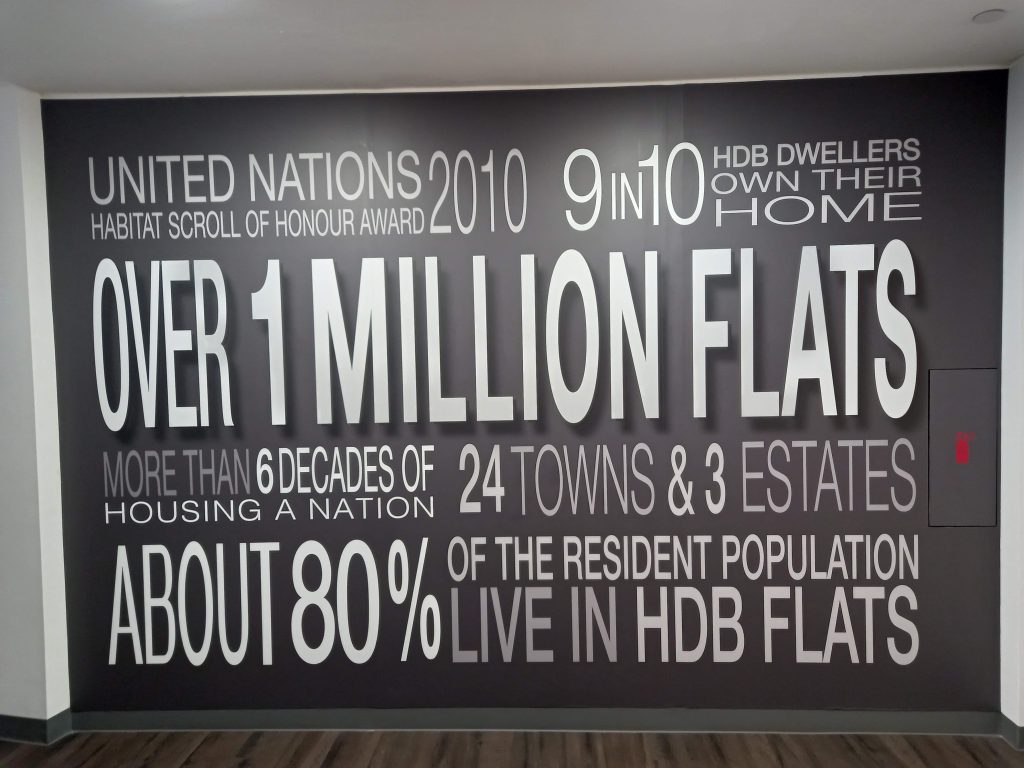
Last Thursday, I went to a very instructive visit of Singapore to discover the HDB. HDB stands for “Housing Development Board” and means council housing. Today, 80% of Singaporeans live in HDB and 70% are owners of their flats. Here, in Singapore, public housing doesn’t have the pejorative meaning it has in France or the UK. This is pretty amazing actually.
Jeudi dernier, je suis allée faire une visite très instructive pour découvrir les HDB de Singapour. HDB signifie «Housing Development Board» c’est-à-dire l’organisme qui gère les logements sociaux. Aujourd’hui, 80% des Singapouriens vivent en HDB et 70% en sont propriétaires. Ici, à Singapour, le logement social n’a pas la même connotation péjorative qu’en France ou au Royaume-Uni. C’est assez incroyable en fait.
Let me give you a bit of background on the history of Singapore. When the British left Singapore in 1959, they took everything with them, people and equipment. Singapore was faced with three serious problems:
- Unemployment. There are no natural resources in Singapore and the population was mostly unskilled.
- Not enough housing. Over the 2 million people living in Singapore at the time, around 2/3 lived in slums. The fear of fire was very serious (a fire would not just destroy a house but an entire area and could kill thousands). But also, hygiene, health and security were not good.
- No army. Very quickly, this problem was solved by establishing a 2-year national service for all boys aged 18.
Voici un peu de contexte sur l’histoire de Singapour. Lorsque les Britanniques ont quitté Singapour en 1959, ils ont tout emporté avec eux, personnes et matériel. Singapour était alors confrontée à trois problèmes graves :
- Le chômage. Il n’y a aucune ressources naturelles à Singapour et la population était majoritairement non qualifiée.
- Pas assez de logements. Sur les 2 millions de personnes vivant à Singapour à l’époque, environ 2/3 vivaient dans des bidonvilles. La peur des incendies était très importante (un incendie ne détruisait pas seulement une maison mais toute une zone et pouvait tuer des milliers de personnes). Mais aussi, l’hygiène, la santé et la sécurité étaient très mauvaises.
- Pas d’armée. Très vite, ce problème a été résolu en instaurant un service militaire de 2 ans pour tous les garçons de 18 ans.
So, imagine, early 60s Singapore: most people living in very bad conditions, earning small incomes and just surviving. The mafia (or triads) was controlling entire districts offering “protection” against money. The British started building social housing before leaving, but they were too expensive for most people who could not commit to a monthly rent (most people didn’t have a guaranteed monthly salary).
Imaginez Singapour au début des années 60 : la plupart des gens vivent dans des conditions insalubres, gagnent des revenus minables et survivent à peine d’un jour à l’autre. La mafia (ou les triades) contrôlait des quartiers entiers en offrant une “protection” contre de l’argent. Les Britanniques ont bien essayé de remédier à la situation en construisant quelques logements sociaux, mais sans succès. Ils étaient toujours trop chers pour la plupart des gens qui ne pouvaient pas s’engager sur un loyer mensuel (la plupart des gens n’ayant pas de salaire mensuel garanti).

Here comes Mr Lee Kuan Yew (read more here), the first Singapore prime minister in 1959. He believed that affordable housing was the foundation for everything: education, health wealth, etc.. With that in mind, he borrowed money form the World Bank and created HDB. To give you a bit of perspective, the British built 30,000 flats in 20 years. The Singaporeans built 15,000 the first year and today there are more than 1 million of flats.
Entre sur scène M. Lee Kuan Yew (plus d’infos ici), le premier Premier ministre de Singapour en 1959. Pour lui, le logement abordable était la base de tout : l’éducation, la santé, etc. Dans cet esprit, il a emprunté de l’argent à la Banque mondiale et a créé HDB. Pour vous donner un peu de perspective, les Britanniques ont construit 30 000 logements en 20 ans. Les Singapouriens en ont construit 15 000 la première année et aujourd’hui il y en a plus d’un million.
The first location was Toa Payoh, located north of Novena. Toa Payoh means “big swamp”. It was a big swamp with a few villages and farmers. The area was controlled by the mafia and police didn’t dare go there. Bear in mind that Singapore was often referred to as the Chicago of the East at this time (to give you an idea…). So why choose this area? Because it was close to the central business area, the government wanted to reduce criminality and to de-isolate small villages. At first, the residents didn’t want to leave their homes and they were supported by the mafia. By 1964, results started to show. Little by little, residents are re-housed in temporary accommodation while a building is built and so one. Farmers were paid by trees for their farms, residents were paid to leave their houses and in the end the Toa Payoh HDB district emerged from the ground.
Le premier emplacement choisi pour ces logements sociaux a été Toa Payoh, situé au nord de Novena. Toa Payoh signifie “grand marais”. C’était effectivement une zone maraicageuse avec quelques villages et fermiers. La zone était contrôlée par la mafia et la police n’osait pas s’y rendre. Il paraît qu’à l’époque, Singapour était souvent surnommée le Chicago de l’Est (pour vous donner une idée…). Alors pourquoi choisir cette zone ? Pour trois raisons : 1. C’était proche du quartier central des affaires ; 2. le gouvernement voulait réduire la criminalité et ; 3. désenclaver les villages. Au début, les habitants ne voulaient pas quitter leurs logements et ils étaient soutenus par la mafia. En 1964, les résultats ont commencé à apparaître. Petit à petit, les habitants sont relogés dans des logements provisoires le temps de construire un immeuble et ainsi de suite. Pour la petite histoire, les agriculteurs recevaient un dédommagement correspondant au nombre d’arbres sur leur terrains. Et il parait que certains arbres se déplaçaient de fermes en ferme ! C’est ainsi que le quartier de Toa Payoh HDB a émergé du sol.


What is very interesting is that they didn’t just build housing buildings, but also shops, schools, hospital, public transport, etc. The concept is that when you live in a HDB, everything is available on your doorstep, no more than 10 minutes away. So not only the flats are affordable, but they were literally building complete communities with everything anyone could need.
Ce qui est très intéressant, c’est que HDB ne s’occupe pas seulement des immeubles d’habitation, mais prévoit tout ce qui est nécessaire à la vie des résidents. HDB crée des quartiers entiers. C’est de l’urbanisme. HDB prévoit ainsi les commerces, les écoles, les lieux de santé, les transports en commun, etc.. Le principe est que chaque résident peut trouver tout ce dont il a besoin à 10 minutes de chez lui. Ainsi, non seulement les appartements sont abordables, mais il construit littéralement des communautés entières avec tout ce dont on a besoin.


Amazing, right? A few points of interest: HDB flats are reserved for Singaporean. They can buy their flats at a really good price or rent it. If you own a HDB, you cannot let it out, but you can sell it to the open market. However, there are restrictions to whom it can be sold to, so that there is a balance of ethnicity in every block. In addition, when a HDB flat is first sold, it has a lease of 99 years. After 99 years, it goes back to the state.
Il faut savoir que les HDB sont réservés aux Singapouriens. Ils peuvent acheter leur appartement à très bon prix ou les louer. Si vous possédez un HDB, vous ne pouvez pas le sous-louer, mais vous pouvez le vendre au prix du marché comme n’importe quel appartement. Cependant, il y a des restrictions, vous ne pouvez pas le vendre à n’importe qui. Il faut qu’il y ait un équilibre ethnique dans chaque bloc. De plus, lorsqu’un appartement HDB est vendu pour la première fois, il a un bail de 99 ans. Après 99 ans, il revient à l’État.
Today, there are 24 HDB cities in Singapore. Each has its own personality. The buildings are maintained regularly, for example the pipes are changed (free of charge for the residents), or the bathroom is refurbished (for an affordable fixed price). Very rarely are the buildings destroyed to be rebuilt. Nowadays, HDB is conscious of being green and avoiding waste. One of the rules is that for each square meter of concrete, a square meter of green area must be created. It is now also possible to buy a flat on plan and to have it built to your own specifications.
Aujourd’hui, il y a 24 complexes de HDB à Singapour. Chacun a sa propre personnalité. Les bâtiments sont entretenus régulièrement, par exemple les canalisations sont changées (gratuitement pour les résidents), ou la salle de bain est remise à neuf (pour un forfait abordable). Très rarement les bâtiments sont détruits pour être reconstruits. De nos jours, HDB est conscient de l’environnement et veut éviter le gaspillage. L’une des règles est que pour chaque mètre carré de béton, un mètre carré d’espace vert doit être créé. Il est désormais également possible d’acheter un appartement sur plan et de le faire construire selon ses propres spécifications.
We spent a long time in Toa Payoh as there is a very interesting exhibition recounting the history of public housing development in Singapore. After that, we went to Tiong Bahru where one of the first public housing projects had been developed there by the British. When they left, Singapore’s HDB took over these buildings and maintained them. They are in the Art Deco style and are now graded. They are absolutely lovely!
Nous avons passé beaucoup de temps à Toa Payoh car il y a une exposition très intéressante relatant l’histoire du développement du logement social à Singapour. Après cela, nous sommes allés à Tiong Bahru où l’un des premiers projets de logements sociaux y avait été développé par les Britanniques. A leur départ, le HDB a repris la gestion de ces bâtiments et les a entretenus. Ils sont de style Art Déco et sont désormais classées. J’adore !


The third complex we went to was Skyville. It is very modern and has an amazing rooftop.
Le troisième complexe où nous sommes allés est Skyville. Il est très moderne et possède une terrasse incroyable sur le toit.


Something interesting is that all HDB flats have a bomb shelter. Interesting to think that Singapore is in fear of being bombarded.
Ce qui est curieux, c’est que tous les appartements HDB ont un abri anti-bombes. Intéressant de penser que Singapour a peur d’être bombardé.

I was really amazed by what has been built: the long-term vision for the people of Singapore. I wish our leaders have this engagement and courage. But there are a few things that bother me a little. Making sure that ethnic communities do not regroup is for integration, yes, but is it not a good way to avoid revolt? All this is restricted to Singaporeans, what about the others? All these workers who come here in search of a better life and work hard and have limited resources? I am not talking about us, expat and privileged, but about the Malay, the Indonesian the Thai, etc. who are doing the jobs nobody wants and are scrapping a living. There is no integration for them and no HDB either.
J’ai été vraiment impressionnée par ce qui a été construit et surtout par la vision à long terme pour les habitants de Singapour. J’aimerais que nos dirigeants aient cet engagement et ce courage. Mais il y a quelques choses qui me dérangent un peu. S’assurer que les communautés ethniques ne se regroupent pas, c’est pour l’intégration, oui, mais n’est-ce pas un bon moyen d’éviter la révolte (diviser pour mieux régner) ? Tous ces logements sont réservés aux singapouriens, qu’en est-il des autres ? Tous ces travailleurs qui viennent ici à la recherche d’une vie meilleure et travaillent dur et ont des ressources limitées ? Je ne parle pas de nous, expatriés et privilégiés, mais des malais, des indonésiens, des thaïs, et autres qui font des boulots dont personne ne veut et qui joignent à peine les deux bouts. Il n’y a pas d’intégration pour eux et pas de HDB non plus.
Very interesting, thank you! did you ever think about adding french guide to your ongoing activities ?? 🙂 regarding your remarks on restrictions, it made me think (on a different level but stil…) to the some of the “ritals” who have built for not much pay and great pains the great riviera buildings in Nice and are now part of the uppers in Nice, not willing to share and open frontiers…
Ahah ! Non, je n’ai pas pense a devenir guide. Mais j’adore l’Histoire et les histoires. Alors, j’en profite 🙂