
I joined Accueil Singapour, a French organisation welcoming new immigrants to Singapore. They organise a lot of things but I am mostly interested in the visits with Diane, a Singaporean lady who speaks French and always has interesting insight about Singapore. The visit of the wet markets was my first visit with the group and Diane. Although I know wet markets for having lived in Hong Kong some time, it was very interesting to hear about the story of Singapore and see a different side of the city.
Je me suis inscrite à Accueil Singapour, une association française pour les nouveaux arrivants à Singapour. Ils organisent beaucoup de choses mais je suis surtout intéressée par les visites avec Diane, une Singapourienne qui parle français et qui a toujours des histoires intéressantes sur Singapour. La visite des marchés a été ma première visite avec le groupe et Diane. Bien que je connaisse déjà les marchés asiatiques pour avoir vécu à Hong Kong un certain temps, c’était très intéressant d’entendre parler de l’histoire de Singapour et de voir une autre facette de la ville.
The visit started by the wholesale centre in Pasir Panjang. The name Pasir Panjang literally means “long sand” in Malay, a reference to the long sandy beach that stretched along the coast in this area. But now, the long sandy beaches are gone and replaced by the huge container harbour. The wholesale centre is where all imported goods are sold. The market is only for professional early morning until 9 am. After that, it is open to the public and regular people (like you or me) can buy food for a very interesting price.
La visite a commencé par le centre de vente en gros de Pasir Panjang. Le nom Pasir Panjang signifie littéralement “long sable” en malais, une référence à la longue plage de sable qui s’étendait le long de la côte dans cette région. Mais maintenant, la plage de sable a disparu et a été remplacée par l’immense port à conteneurs. Le centre de vente en gros est l’endroit où toutes les marchandises importées à Singapour sont vendues. Le marché est réservé aux professionnels tôt le matin jusqu’à 9h. Après cela, il est ouvert au public et les gens ordinaires (comme vous ou moi) peuvent acheter des produits à un prix très intéressant.


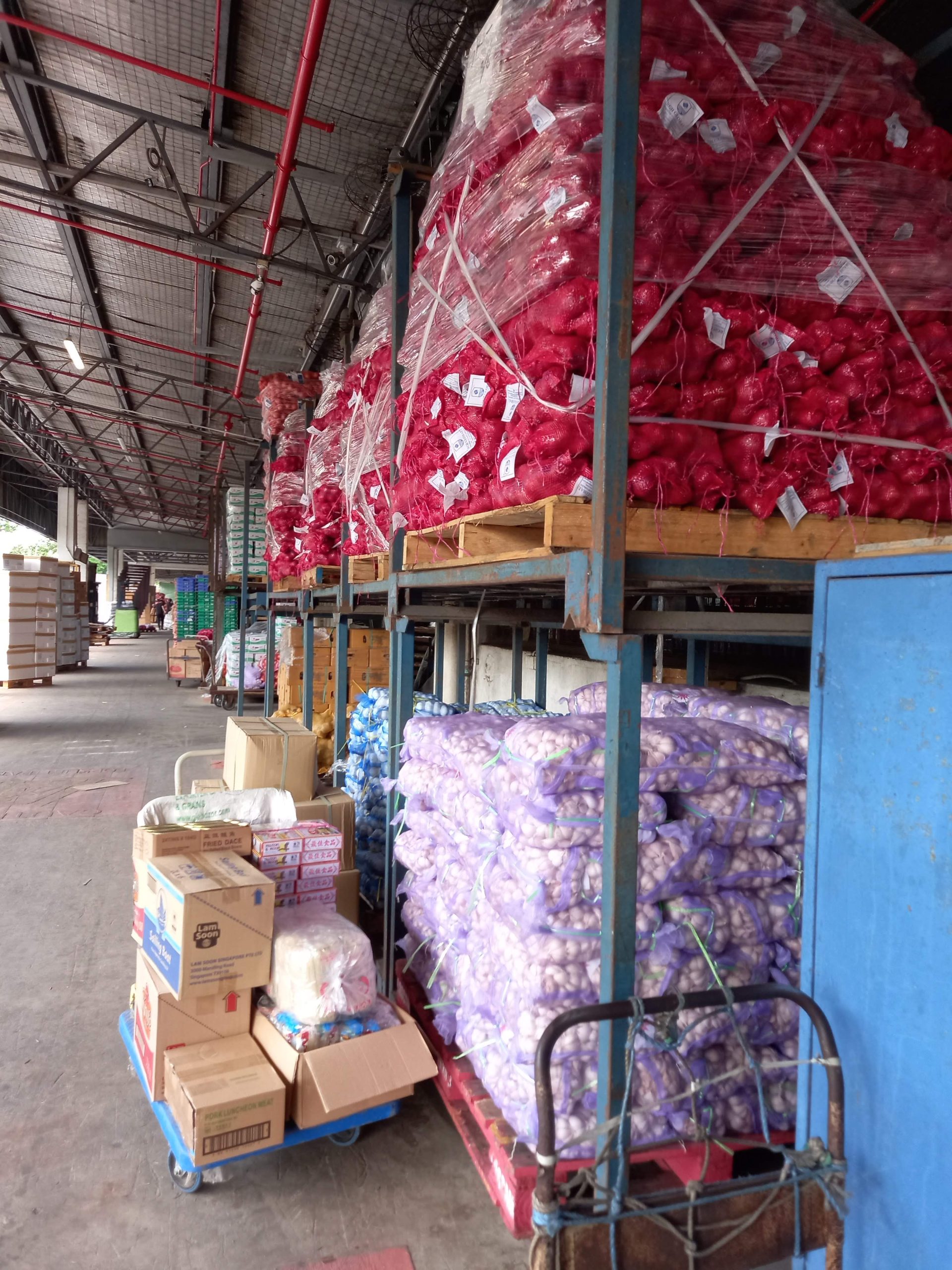


The place was amazing. There were so many things, lots of colours. Chinese love century eggs and they are very expensive. As a consequence they are treated with a lot of care. There was an alley specialised in import of such eggs and each shop had their little altar to make sure nothing bad would happen to the eggs.
L’endroit était incroyable. Il y avait tellement de choses et beaucoup de couleurs. Les chinois adorent les œufs de 100 ans et ils sont très chers. Du coup, ils sont traités avec beaucoup de soin. Il y avait une allée de petites échoppes spécialisées dans l’importation de ces œufs et chaque magasin avait son petit autel pour s’assurer que rien de mal n’arriverait aux œufs.


Next stop was Geylang Serai Market in the Geylang area. This is a Malaysian market. On one side, there is the dry market with all the spices, dried food, vegetable, flowers, etc. and on the other side, there is the wet market with meat and fish. On the first floor, there are clothes stalls. In every wet market, there’s a hawker centre where you can eat simple dishes for nearly nothing but with no luxury. Singaporeans love eating and according to Diane, heaven would be to always have something in the mouth. The best compliment for a Singaporean is to tell them Singapore food is amazing!
Le prochain arrêt était le marché de Geylang Serai dans le quartier de Geylang. C’est un marché malaisien. D’un côté, il y a le marché « sec » avec toutes les épices, aliments séchés, légumes, fleurs, etc. et de l’autre côté, il y a le marché « humide » avec la viande et le poisson. Au premier étage, il y a les vêtements.Dans chaque marché, il y a un « hawker centre » où vous pouvez manger des plats simples pour presque rien mais sans luxe. Les Singapouriens adorent manger et selon Diane, le paradis serait de toujours avoir quelque chose dans la bouche. Le meilleur compliment que vous pouvez donner à un Singapourien est de lui dire que la nourriture de Singapour est incroyable !


The lady in front of the flowers is making pot-pourri with fresh flowers, to perfume the bath or the house. Her hands were so agile picking up the flowers. Another stall that I liked was the spice stand. The lady could make you any spice assortment you wish.
La dame devant l’étal de fleurs prépare des pots-pourris avec des fleurs fraîches, pour parfumer le bain ou la maison. Ses mains étaient si agiles pour attraper les fleurs. Un autre stand que j’ai aimé était celui des épices. La vendeuse peut vous faire n’importe quel assortiment d’épices que vous souhaitez.
The last stop was the Chinese market in Chinatown. Very much like the ones I saw in Hong Kong. But we did a few new things. First we went to a stall that sells black-skin chickens. It is a variety of animals that have a dark skin. I never saw anything like that before. We also got to taste the century eggs. They are not 100 year old, obviously! The raw eggs are wrapped in straw and put in a preserving liquid for some time. The white becomes blackish and becomes jelly-like. The yellow takes a dark colour and is not runny anymore. The taste is special but not disgusting. I’m happy I tried!
Le dernier arrêt était le marché chinois de Chinatown. Très semblable à ceux que j’ai vus à Hong Kong. Mais j’ai fait quelques découvertes. Nous sommes d’abord allés à un étal qui vend des poulets à peau noire. C’est la variété de poulet qui est comme ça. Je n’ai jamais rien vu ça avant. Nous avons également pu goûter les œufs 100 ans. Ils n’ont pas 100 ans, évidemment ! Les œufs crus sont enveloppés dans de la paille et mis dans un liquide de conservation pendant un certain temps. Le blanc devient noirâtre et gélatineux. Le jaune prend une couleur sombre et ne coule plus. Le goût est spécial mais pas dégoûtant. Je suis contente d’avoir essayé !


The visit was finished, but I spotted a few more interesting things on my way back to the MRT (that’s the name of the underground in Singapore). There was a nice mural with Bruce Lee on the wall of the Chinatown wet market that I liked. The market is just next to the Buddha Tooth Relic Temple, a beautiful building. I also saw a shop selling tassels of all sizes and colours. I could have stayed all day looking at all of them!
La visite était terminée, mais j’ai repéré quelques autres choses intéressantes sur le chemin du retour vers le MRT (c’est le nom du métro de Singapour). Il y avait une belle peinture murale avec Bruce Lee sur le mur du marché de Chinatown que j’aimais bien. Le marché est juste à côté du Buddha Tooth Relic Temple, un bel édifice. J’ai aussi vu une boutique vendant des pompons (je ne suis pas sûre du mot en français) de toutes tailles et couleurs. J’aurais pu rester toute la journée à les regarder tous !


Don’t hesitate to look at the Geography (Singapore) page to check where everything is!
N’hésitez pas à regarder la page “Geography (Singapore)” pour vous repérer !